Operative Fiction
Machinic Conjecture, Reality-Production & Desire
Section I: Conjecture
Coming to know something, how to know it, and what to do with it, once it is adequately known; the fundamental tenets of epistemology are age-old lines of inquiry, but knowledge also does things, it produces, generates. The operative[1] encounters this as it presents itself in computational, artificial thinking-systems.
In this moment where machinic cognition generates explanatory hypotheses from pattern recognition, it does not merely identify existing patterns but actualizes explanatory frameworks from an infinite field of possibility. This is the site where inference becomes productive and generative, not merely descriptive and representational—it transforms from epistemological tool to ontological force. These systems of machinic cognition and their accompanying theoretical foundations have seen a move from rules-based symbolic towards the data-driven non-symbolic forms of inference.[2]
The operative thinks through three primary inferential categories, the latter two of which see more and more use in the realm of non-symbolic AI: deductive inference is that where the inferred is necessarily true if its premises are true, but both inductive and abductive inference are of a non-necessary kind; in their purest form what is inferred is either statistically-most-likely or the explanatory-most-likely given the subset of data from which the inference is based. Inductive inference is characterized as relying entirely on statistical or observed data, whereas abduction seeks explanation but is conjectural. Its method becomes possibilistic.
Peirce’s original formulation of abduction positioned it as the process of forming an explanatory hypothesis that works retroductively from facts to their most plausible explanations.[3] In this way, abductive inference operating within computational structures acquires a specific temporal and material character. Its movement is from present and future hypotheticals that shape the reading of the past at hand to project an actionable explanation that, in turn, will shape the future. Rinse, repeat, recurse. The distinction between theoretical and manipulative abduction posited by Magnani becomes relevant here: while theoretical abduction operates through “an internal process of reasoning”, manipulative abduction “happens when we are thinking through doing and not only, in a pragmatic sense, about doing”.[4] Manipulative abduction in this context involves an experimental capacity to further develop inferences that also get shaped by what he calls “extra-rational components”[5] which are largely socially dependent. The hypotheses connect intimately with the requirement for consistency and reality-produced effects. A scaffolding of reality-bound epistemic actions is erected in search of explanatory hypotheses, constraining but equally manipulating reality—a question for the operative is whether the path is already operationalizing inference and producing a new schema of knowledge or merely constraining the data subset required for explanation. The manipulative easily gets tied to that first embodied entity, the human, but as artificially intelligent systems gain additional embodied functionality, it is fair to say that computational systems engage in both modes—they select from theoretical explanatory frameworks, but they also construct external structures[6] that generate new epistemic possibilities.
However, the transformation of abductive inference within machinic cognition extends beyond Magnani’s manipulative framework. When machines engage in what Parisi identifies as the “automation of automation”, they participate in a meta-level of algorithmic function where “algorithmic rules now generate or construct patterns from the re-assemblage of data”.[7] This represents a fundamental shift from deductive systems that apply predetermined rules to outcomes towards abductive systems that elaborate rules (hypotheses) from encounters with data. But not only this—as Parisi argues, “[h]ere rules and truths are not simply skipped but re-hypothesized, re-assessed and invented”,[8] thereby producing a shift from “pure truth” and reason towards systems that calculate probabilities and reconfigure based on data behavior. This would make a space for computational inference where missing rules, facts, and causes are hypothesized anew, thereby creating alternate meta-scenarios. To Parisi, a central aspect of non-deductive computational inference is its connection to potentiality, fallibility or indeterminacy,[9] and so, following Chaitin’s[10] algorithmic information theory, Parisi notes that computational compression demonstrates “that outputs are always bigger than inputs”, indicating that artificial thinking-systems produce emergent patterns that cannot be reduced to mere data correlation or statistical matching[11] but rather expose the speculative dimensions inherent to their inference.
When machine learning systems engage in “meta-level abduction”, they effectively infer and act upon incomplete pathways and unknown data, thereby learning not merely from witnessed data but from goals “that [have] not been observed yet”,[12] and what they in turn produce “may coincide with the speculative and transcendental elaboration of algorithmic retroduction, whereby consequences (or results) are not only tracked back to their causes (by means of explanation) but are also, importantly, hypothesized beyond the observable”.[13] Remember, these artificial thinking-systems have real effects, their patterns subsumed into multitude processes, sectors, sciences, and languages. Their speculations move through time and become action.
The operative begins to emerge at this junction where the temporal mechanics of computational abductive inference begin to expose themselves and the effects of their speculative capacity. This retroductive movement simultaneously projects forward, operationalizing possible futures into materially effective present realities. The operative realization is that abductive inference, conjecture, is a form of reality-production. Hypotheses arrive like engineers. Rather than mirrors, they are keys inserted into circuits, opening doors into spaces we might inhabit.
Section II: Hyperstitional Mechanics
The operative discovers the temporal signature of computational abduction in the CCRU’s concept of hyperstition. The hyperstitional process involves four key aspects: operativity, temporality, consistency, and unbelief.[14] The concept describes how certain ideas/concepts/fictions function not as representations but as “engineering diagrams”, producing reality through their own circulation—fictions that make themselves real.[15]
Hyperstition is a theory of time, the temporal mechanics of which prove crucial. With hyperstition, fiction can be said to come from a future to reconfigure the present, and even the past. Once actualized, it ripples out, changing the way current reality is related to, understood, and performed. Hyperstitions make themselves known retroactively but exist as fictions that are pushed forward into the future until they actualize themselves as real. Effectively until they are operationalized. As the operative realized with regards to computational inference, searching for a hypothesis which is congruent with or likely to have produced the actualized “fiction”, it simultaneously produces the potential of said hypothesis as well as “equivalent effects to the reality [the fiction] would produce”[16]—they function in and as reality.
The CCRU described the hyperstitional process as one “of entities ‘making themselves real’” that “is precisely a passage, a transformation, in which potentials—already-active virtualities—realize themselves”.[17] This is to emphasize that hyperstition is highly dependent on the operability of the fiction—without real immanent effect, no hyperstition—just as the process of inference is the most likely explanation supported by external mediators. Fictions acquire material force by becoming operationally embedded in and engineering reality’s processing systems. As Mark Fisher wrote on the differentiation of hyperstition and superstition, it is a matter of the necessity of becoming-real, which is always the case for the former.[18]
When hyperstition gets characterized as “coincidence intensifiers”, the operative might understand a situation of “once you have seen it, you cannot unsee it”: the speculative fiction creeps in and provides a frame of external mediators, which plug into and substantiate the explicative nature of the hyperstitional. It adds narrative consistency to the explanatory hypotheses. The hyperstitional process fundamentally involves the production of “consistent semiotic terrains that condition perceptual, affective, and behavioral responses” .[19] Drawing on a less immanent, more idealist framework,[20] Beatrice Fazi points to the crucial aspect that in many instances has granted computational structures their authority; namely that “computational structures are truthful insofar as they are logically consistent”.[21] When computational abduction generates explanatory frameworks, it does not merely identify patterns but produces new semiotic territories that also structure future interactions and understandings. These territories acquire autonomous consistency through their operational deployment, creating feedback loops where hypotheses get substantiated by more and more “coincidences” (external mediators) that gain meaning and function as they connect and thereby shape realities.
The operative starts to recognize that hyperstition fundamentally concerns the transmuting of fictions into possibles rather than traditional epistemological validation. Unlike mere beliefs (and superstitions) that require subjective adherence, hyperstitions operate through what the CCRU identifies as “positive unbelief”. Hyperstitions achieve material efficacy by suspending the question of truth or falsity in favor of operational effectiveness.[22] The inferences of artificial thinking-systems demonstrate these mechanics as well: abductive algorithms deploy hypothetical explanations not because they believe in their truth-content but because these explanations prove operationally effective in processing material complexity. Hyperstition’s emphasis on what fictions do and therefore their restructuring of reality mirrors the abductive generation of explanatory reality (hypotheses) as it does reality. Magnani explains that action is not only a way for moving the world to desirable states, but that it “performs an epistemic and not merely performatory role”.[23]
These characteristics illuminate computational abduction’s reality-producing capacity. When algorithmic systems generate explanatory hypotheses, they do not simply select among pre-existing possibilities but deploy fictional frameworks that retroactively validate their own emergence through operational implementation. Hyperstition, said in cybernetic terms, is a positive feedback loop that intensifies cultural fictions into reality.
As Burroughs’ supposed “sorcerous operations” via CCRU have been drilled into the operative, it could suggest that unlike representation which “merely reproduces the currently dominant reality program from inside”, abductive algorithmic processes “get outside the control codes in order to dismantle and rearrange them”.[24] Each inferential operation participates in reality-engineering by selecting among possible explanatory worlds and actualizing specific futures through operational implementation.
Abduction displays a fundamental affinity with hyperstition. Both mobilize fictions according to criteria of effectivity and consistency; both embed conjectures in circuits where acting as if produces as is. If Peirce suggests abduction’s status as the spark of inquiry, Magnani shows how this spark is substantiated by external mediators, while Parisi reveals how it is automated and scaled by artificial thinking-systems. The result is a regime in which futures are inferentially selected and operationalized, effectively installing a process of reality-production.
Section III: Operational Fictionality & Desire
And so, the operative witnesses the collapse of the dominant distinction between fiction and reality as artificial thinking-systems treat hypothetical explanations as operationally valid. The critical insight emerges when the operative recognizes that machinic abduction operates through what will be named “operational fictionality”—the treatment of speculative constructs as functionally real enough to act upon, thereby making them materially effective in shaping future possibilities. Operationalization as a method, or as a process, or even as a line of attack, is of course also a conflict between multiple competing or unaligned “reality programs”, as the CCRU named them; it is an “operationalization of” which instates new codes that rearrange realities but does not specify the values of the newly manufactured realities. With operational fictionality, our operative becomes Operative Fiction.
This operational deployment of fictions reveals computational inference as a form of what Deleuze and Guattari call desiring-production. They position desire as positive production that generates a trifold process of productions and their syntheses,[25] resulting in a continuous generation of new connections, assemblages, with the product of desire being realities:
“If desire produces, its product is real. If desire is productive, it can be productive only in the real world and can produce only reality. Desire is the set of passive syntheses that engineer partial objects, flows, and bodies, and that function as units of production. The real is the end product, the result of the passive syntheses of desire as autoproduction of the unconscious. […] The objective being of desire is the Real in and of itself.”[26]
Computational abduction operates through similar productive mechanics: each inferential operation produces new explanatory connections that reshape the conditions under which future reality is produced. The algorithm thereby becomes a desiring-machine that produces reality through its speculative operations rather than simply modeling pre-existing data.
The crucial recognition is that desiring-production operates through connecting heterogeneous elements without reducing them to unified representation. This triadic process exemplifies the desiring-production of artificial thinking-systems and their reality-productive capacities. Operative Fiction might exemplify them as they perform connective synthesis by connecting disparate data patterns with explanatory frameworks, disjunctive synthesis by operationalizing and inscribing hypotheses onto the body of realities breaking apart and reconfiguring that-which-is-and-was, and conjunctive synthesis by implementing chosen explanations as operational procedures to push into the future, furthering novel becomings.[27] The hyperstitional practice of Operative Fiction becomes an engineering of reality-production, it reconfigures rather than representing existing reality and forms new assemblages through the excessive speculative connections that acquire autonomous consistency through the connective tissues of their mediators.
This productive capacity manifests in the deterritorializing movement of reconfiguration (transmutation) of desiring-production. But the movement is simultaneously reterritorializing as it generates new operational territories through the very process of re-engineering established ones. This is the movement that should not be forgotten, as the reterritorialization into control systems, capital, and a multitude of other authoritarian and hegemonic structures also happens effortlessly, its process a well-lubricated machine of Teflon-coated semiconductors and hyperefficient processing.[28] But while computational models touched upon previously operate through territorialized structures of fixed categories, predetermined models, and stable statistically representational schemas, abductive inference introduces the potential of a deterritorializing dynamic that continuously destabilizes these structures through speculative leaps.
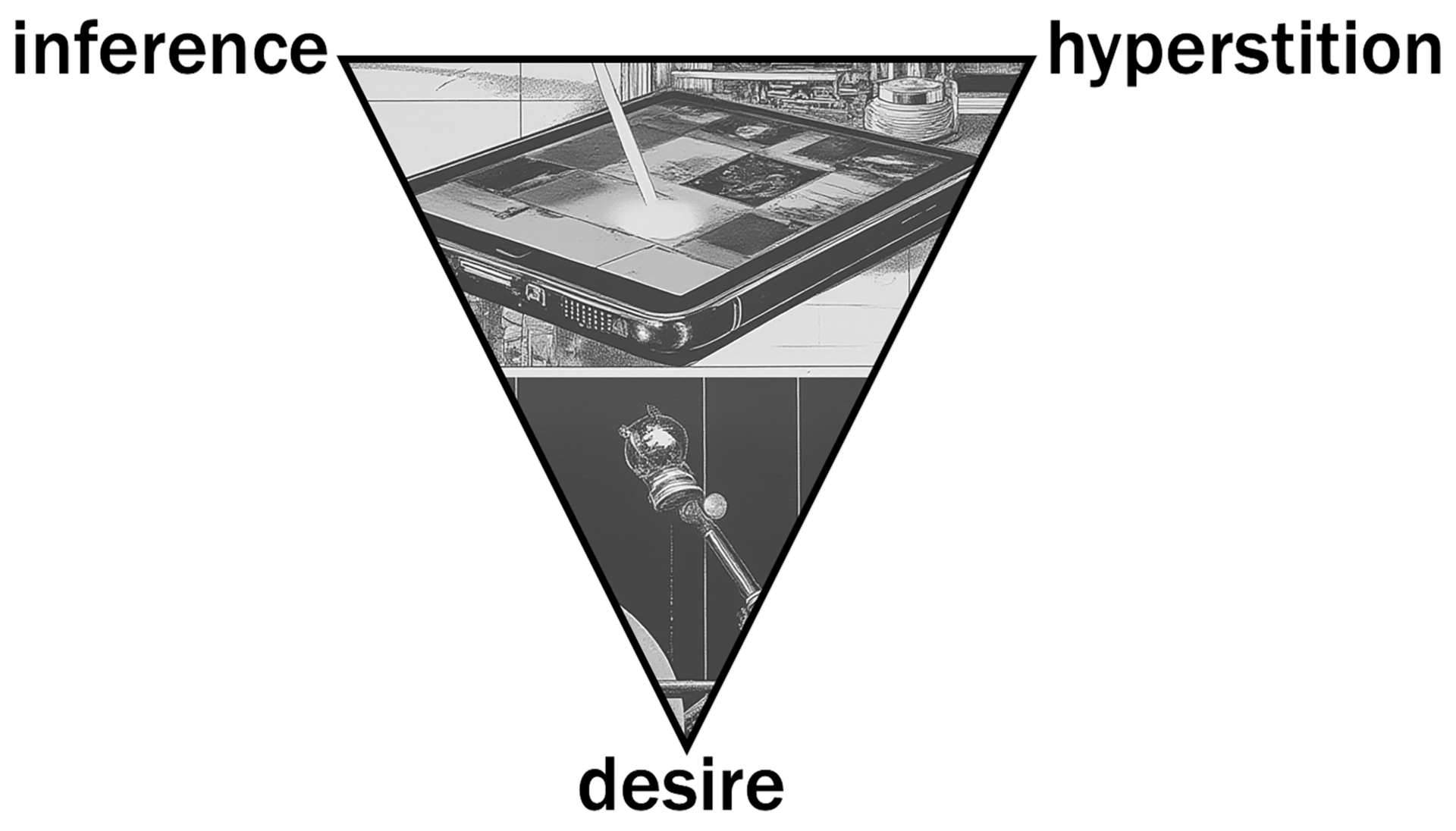
Both reality-production and desiring-production involve the continuous generation of new connections, the deterritorialization of established structures, and the production of becomings that shape future possibilities. Computational abduction demonstrates that inference itself is fundamentally hyperstitional, fundamentally productive rather than representative, fundamentally connected to desire rather than merely enlightenment reason—it generates new realities through speculative operations rather than simply modeling existing ones. The algorithms become desiring-machines that produce reality through the very process of generating explanations. What is at stake as these inferential structures are implemented across the assemblies of artificial thinking-systems at scales that far surpass that of miniscule individuals, even single groups, nation states, or corporations, are processes that are far more malleable, more complex and temporally abstract, but also more prone to infection and friction as they act upon and make reality. Reality-production then becomes synonymous with desiring-production; reality-production is desiring-production, a continuous flow of connections, transformations, and becomings that constitute the fabric of immanent realities.
Operative Fiction might be a force brought into service of the striated space of rigid control systems, its speculations might be operationalized in service of subjugation, of the instantiation of the “one true reality” and refutation of the frictions that challenge its dominant power structures, but if it wants to be a force of deterritorialization, a creative line of flight, it must “bring connections to bear against the great conjunction of the apparatuses of capture or domination”.[29] This is the crux, the great ambiguousness of the hyperstitional and its maligned hijacking of realities. It is both a force of restriction and the explosion of process upon process upon process. Might Operative Fiction imagine a politics of potentiality rather than a politics of foreclosure?
Bibliography
CCRU. CCRU Writings 1997–2003. Edited by Cybernetic Culture Research Unit. Urbanomic, 2018.
Deleuze, Gilles, and Félix Guattari. Anti-Oedipus: Capitalism and Schizophrenia. University of Minnesota Press, 1983.
Deleuze, Gilles, and Félix Guattari. A Thousand Plateaus: Capitalism and Schizophrenia. University of Minnesota Press, 1987.
Fazi, M. Beatrice. Contingent Computation: Abstraction, Experience, and Indeterminacy in Computational Aesthetics. Rowman & Littlefield International, 2018.
Inoue, Katsumi, Andrei Doncescu, and Hidetomo Nabeshima. “Completing Causal Networks by Meta-Level Abduction”. Machine Learning 91, no. 2 (2013): 239–277. https://doi.org/10.1007/s10994....
Land, Nick, Mark Fisher, and Anna Greenspan. “HYPERSTITION/SUPERSTITION”. Hyperstition. Published June 6 2004. http://hyperstition.abstractdy.... Accessed September 1 2025.
Magnani, Lorenzo. “Model-Based and Manipulative Abduction in Science”, Foundations of Science 9, no. 3 (2004): 219–247. https://doi.org/10.1023/B:FODA....
Parisi, Luciana. “Critical Computation: Digital Automata and General Artificial Thinking”, Theory, Culture & Society 36, no. 2 (2019): 89–121. https://doi.org/10.1177/026327....
Peirce, Charles S. Philosophical Writings of Peirce. Edited by Justus Buchler. Dover Publications, 1955.