Mode of Liaisons
An Operational Epistemology
Systems Behind Our Backs
Screens seize, institutions retract, weather breaks: the body adjusts before thought arrives. Jean-Pierre Caron, following Alfred Sohn-Rethel, names this real abstraction:[1] a spatio-temporal operation working “behind our backs”, pre-formatting conduct prior to recognition. Unsettling, yet familiar. The critical outside collapses, and as Michel Foucault shows, power/knowledge circulates without a sovereign vantage. The task shifts from interpretation to inventing procedures that learn by operating within the fields they diagnose.
This poses a transmission problem: how to navigate when orientation’s substrate stays opaque and totalities refuse capture; how causal abstraction gains conceptual traction without reinstalling the Myth of the Given?[2] Operations move first: timings, thresholds, protocols. “Choice” arrives late. Movement congeals as habit. Algorithmic capture sets attention’s tempo: institutional breakdown corrals us through pre-scripted corridors; ecological turbulence forces recalibration before meaning crystallises. To orient is to find oneself already oriented.
Where critique loses altitude, invention becomes necessary. Under that pressure, fiction arrives as thought-in-motion. Poetics modulates the ground: an epistemic operation that changes what can take form. Theory-fiction proceeds by traversal, reading gradients as generators of thought.
This essay works in that terrain. It advances Mode of Liaisons as a transdisciplinary method for producing knowledge through rule-driven propagation across shifting fields. The argument unfolds in three movements: first, from Caron’s real abstraction and José Arthur Giannotti’s operational scheme[3] to Samuel Beckett’s Quad as operational theatre, where demand crystallises into pattern and remainder becomes trace; second, through the articulation of Mode of Liaisons and its six-zone apparatus, coupling terrains by constraint; third, toward epistemic weather, where knowledge drifts from persuasion to persistence, from statement to propagation.
Beckett’s Operational Theatre: From Synthesis to Subtraction
Four hooded figures in identical gowns—white, red, blue, yellow—enter a dimly lit square (six paces a side) on a black stage. Each follows fixed paths along sides and diagonals, swerving the central danger zone ∅ (void) so the centre is never stepped in. They enter and exit in strict permutation. In Quad I, each player is keyed by a colour, light, and a soft intermittent percussion line so that footsteps periodically surface. Quad II inscribes the same scheme in monochrome: white gowns, no percussion, slowed tempo. The camera is raised, frontal, fixed; the work is composed for the television frame. No psychology, no plot—only recursive traversal around an inaccessible centre.
To grasp the radicality of this operational reduction, set Quad against the synthesis it refuses. In Richard Wagner’s Gesamtkunstwerk, the separate arts annul into a single apparatus, a creative destruction yielding immersive fusion. Audiences are entrained rather than addressed; rhythm and motif pre-format attention before reflection. By analogy with real abstraction and Wilfrid Sellars (as mobilised by Caron), the point is not simply prior capture but concealment: the scaffold dissolves into sensation, and consensus is secured as experience rather than argued into belief.
Quad inverts the vector. Less play than signal, it operates as a coded instruction set for broadcast. Fixed frame, colour channels, periodic sequencing, centre-avoidance: in Giannotti’s terms, an operational scheme. Following Sellars’s critique, it exposes the Given by showing how procedures condition perception ahead of concept. In Quad’s grammar, entrainment persists through reduction. Recurrence and exposed choreography retune attention to the rule-field instead of synthetic immersion. Subtraction becomes exposure; patterning leaves remainder; exhaustion does the disclosing. Here, movement turns functional; gesture computes.
Yet Quad exceeds austere negation.
It exposes the scaffold of synthesis. Constraint renders enactment legible: every path governed, every entrance sequenced, even “silence” composed. When percussion withdraws and footfall surfaces, exhaustion becomes score. Exhaustion indexes the rule-field that produces it: the square, centre-avoidance, tempo, permutations. Subtraction is the bone of the operation. But what enables this? What upholds a ruin that still performs? What makes exhaustion functional rather than merely entropic? How does pattern condense into rule without collapse?
The answer is demand. The piece begins with compositional imperatives, not ideas. Operational purity is choreographed; the diagram is executed. Performers move under conditions that precede them; their paths instantiate a demand to abstract—geometry before psychology. This is activation’s ontology: constraint is summoned as well as endured; the path is given and made at once. Rules limit and inaugurate; they bring the operation into being and are written by the traversal they govern. The performers do not move across a pre-existing ground; they generate ground through movement. This is the walking paradox: the walk discovers a ground as it composes it.
Wagner and Beckett both organize demand through form, along contrary vectors. Wagner blurs the edge, unity-before-difference, a saturation through myth that pre-empts mediation. Quad refuses synthesis and reveals the norms that drive patterned behaviour. Abstraction emerges within Quad as the rule-field runs until it shows itself. Ruins function as a diagram: procedures by which patterns generate fatigue and become legible.
Quad learns through inscriptive repetition. Residues, micro-slurs, hesitations, near misses become parameters; each pass writes updates into rhythm, spacing, sequence. These feed back into the rule-field, changing conditions so subsequent passes run on altered ground. Exhaustion registers what the scheme cannot yet accommodate and converts that remainder into constraint. In this register, ruin functions as a medium: it carries information that retunes the run.
Wagner fuses to conceal the scaffold; Beckett pares to show it; Mode of Liaisons composes with it; synthesis transmutes to operational modulation.
Mode of Liaisons: Constraint as Generative Method
Mode of Liaisons generalises Quad’s operational lesson. Where Quad leaves residue and Wagner conceals it, exhaustion reads as the trace of overrun. Exceeded tolerances become material for transduction into new constraints and parameters. Beckett’s piece shows how working inside limits yields knowledge; Mode of Liaisons extends this across domains, treating constraint as generative and converting residual exhaustion into operational information.
Rules lay infrastructure; they summon action and give the run memory. A liaison occurs when a move propagates as a pattern across domains; unresolved outcomes carry forward as settings for the next pass. Resistance becomes tension and cadence within the field. The result is modulation under pressure: the field learns by writing its limits into the next operation. This is the threshold to Poetics-Logic, where poetics inscribes trace and relation, and logic articulates the grammar of demand.
The stance is internal. Start with a rule set—explicit for execution, porous to remainder. Run until residues surface: fatigues, hesitations, misalignments. Treat residue as information, not error. Retune tempo, thresholds, density, relays; run again. Across runs, demand precipitates provisional norms while pressure keeps them plastic. Heterogeneity is held in productive tension.
This is normogenesis:[4] the recursive production of norms without reinstalling the Given. Through inscriptive repetition, constraints transduce remainder into further constraint. The traversal (conditions → run → remainder → constraint → norm) keeps poetics and logic in oscillation. Learning proceeds by recursion; knowledge sediments into articulation at intervals. Epistemology moves in time: does this operation continue to generate usable difference, and can it infect other sites?
From Giannotti’s operational turn, Poetics-Logic emerges as the onto-epistemic ground: a constrained run-in which cuts (poetics) and rules (logic) co-compose, transducing remainder into parameter and condensing knowledge in time. The method becomes ontological prototyping: rehearsals under constraint that test new coordinations and read what returns. In Beckett’s Quad, encounter-pressure rewrites the ground; micro-hesitations and wear reconfigure the very conditions that produced them. As the circuit runs, its logic becomes navigable without becoming transparent; the inaccessible centre begins to steer trajectories that can be felt, timed, tuned. The operation is legible in its rule and generous in its leak.
A liaison preserves asymmetry—each side alters without full translation. As a transductive relay, it retimes small differences so patterns travel while autonomy holds. Propagation generates rather than merely transmits: pattern → remainder → parameter → updated rule-field. When gradients steepen, phase jitter and collisions yield usable disorder—order flashes from turbulence, brilliant chaos. What overruns one site is tuned as a parameter in the next; articulation couples unlike domains without collapse.
A transductive relay functions architecturally through atmospheric pressure as its phase-shift mechanism. Tempo, saturation, density, thresholds—these differentials mediate translation. Pressure lets patterns traverse domains by shifting phase between modalities; it calibrates orientation, introduces ambiguity, and holds hypotheses in suspension long enough for form to emerge. It creates a buffer zone where the field’s responsiveness retunes to what it cannot yet name. A rule can make a climate; a body can serve as a vector and a sensor; in this register, exhaustion yields knowledge.
These principles require spatial instantiation. Pressure differentials do not operate in abstract space; they form zones of characteristic intensity, each demanding specific navigation protocols.
Epistemic Topologies: A Six-Zone Apparatus
Mode of Liaisons supplies the grammar; the six-zone apparatus is the instrument. Theory-fiction, here, is a method: a pressure-field topology for testing how transductive relays, operating through atmospheric pressure, generate navigational knowledge. Think of the apparatus as a tension zone—an overlay where a not-yet landscape meets the already scripted. The transductive relay is the figuring seam at that contact: a provisional field for navigation. Conditional by design, the model renders the familiar strange and opens a buffer for reorientation. Each zone names a characteristic pressure and sets a protocol for entry and movement. The fiction is in the model; the traversal is real. What the walk yields cannot be reduced to the fiction, nor the fiction to the walk. Here, spatial epistemology acts as a rhythmic, ontogenetic force shaped by absence, latency, and transductive interaction.
What follows maps six fronts where epistemic weather condenses; each zone is a pressure-field where rules meet matter and leave a trace.
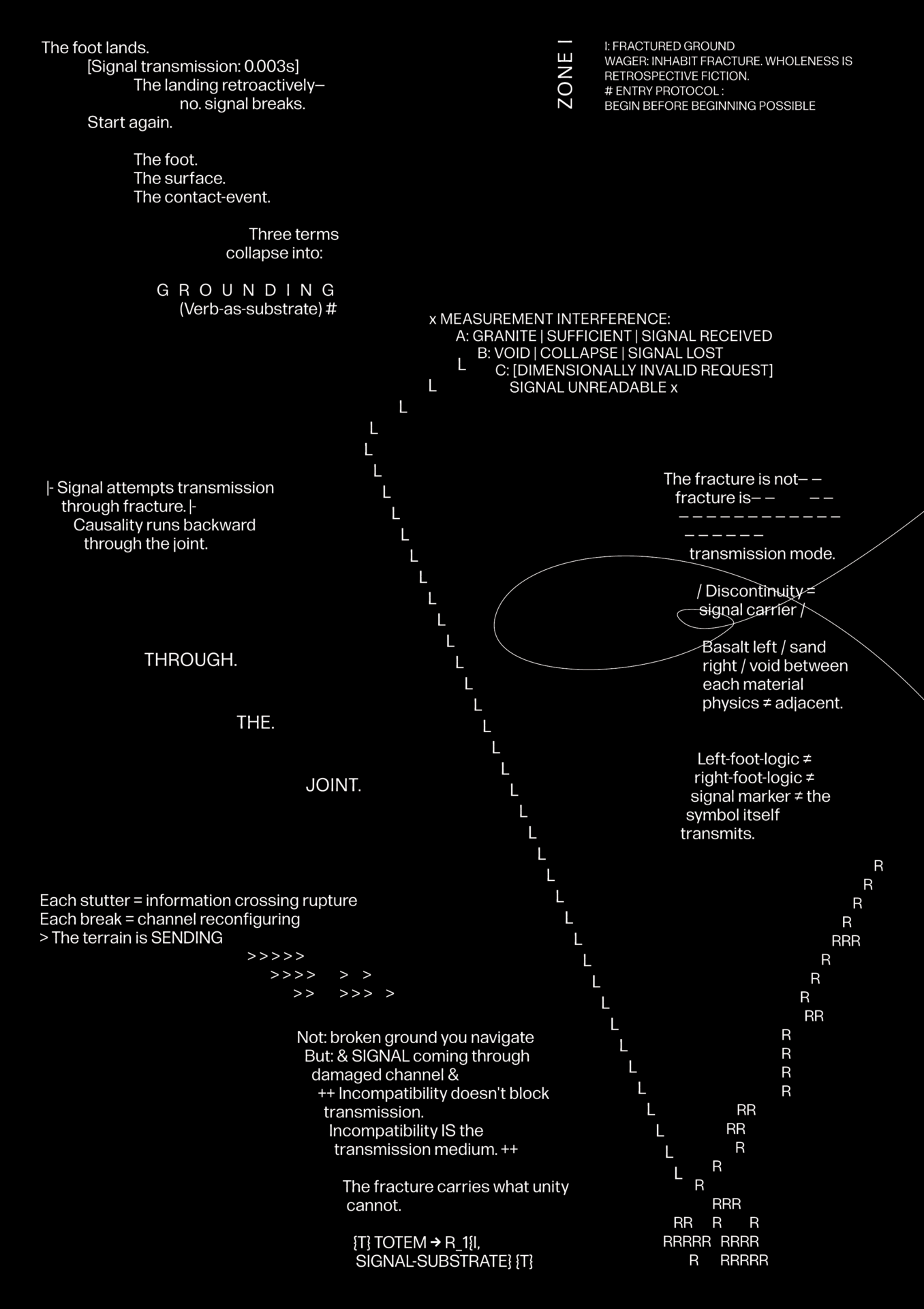
Zone I: Fractured Ground (⋮)
Coordinates: (Beginning without Origin)
The zone presents epistemic fissures. Subjects emerge from the terrain they traverse. No exterior position. Traversal is an investigation. Ground is ontological multiplicity. Fracture is a Mode of existence.
Entry Protocol: Begin mid-step. Accept incompatible measurements as simultaneously valid.
Primary Operation: Maintain movement across incommensurable physics. Left-foot logic ≠ right-foot logic.
Trace Deposit: Error accumulation crystallises into infrastructure.
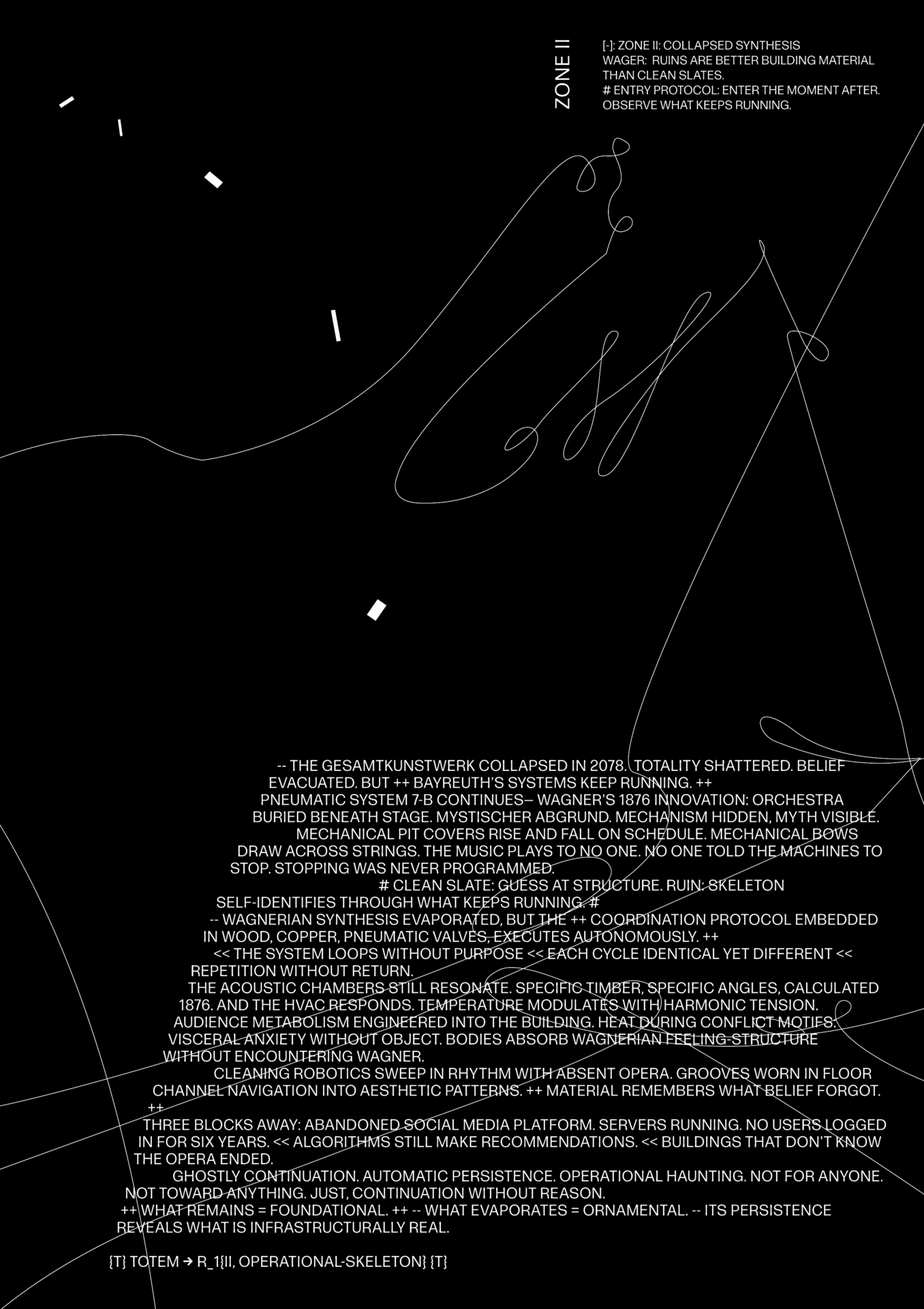
Zone II: Collapsed Synthesis (⊟)
Coordinates: ≈ 49° 57′ N, 11° 34′ E (Bayreuth—post-mythic debris field)
Terrain Features: Abandoned Orchestral Pits; Shattered Leitmotifs; Calcified Aesthetic Matter
Phenomenon: Pattern Persistence After Belief
Collapsed Synthesis metabolises the ruins of totalised systems. After Wagner’s Gesamtkunstwerk fails, operational residues persist: rhythmic patterns, structural logics, organisational schemata that continue to function after their mythic content is evacuated. Traversal here requires learning to work with collapsed totalities’ material persistence. Subtraction operates as a method, creating conditions for differential intelligence through algorithmic precision (runnable pattern extraction). Ruins become a resource; operational logic outlasts mythology.
Entry Protocol: Identify a repeating pattern divorced from the original purpose. Engage the pattern as pure operational residue.
Primary Operation: Extract a coordination schema from evacuated content. Metabolise ruins. Retain organisational pressure independent of mythology.
Trace Deposit: Algorithmic residue available for differential activation. Pattern becomes portable infrastructure.
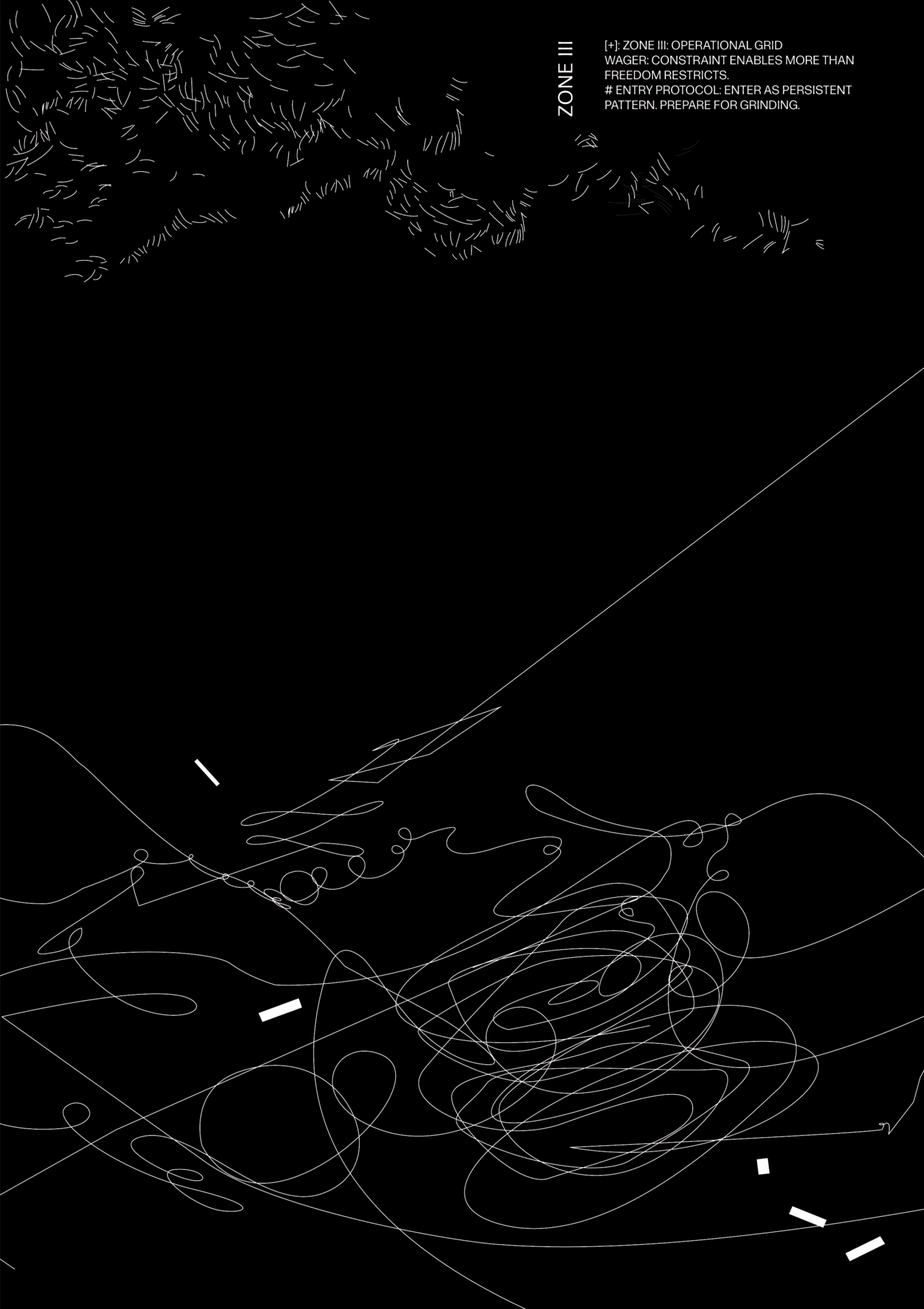
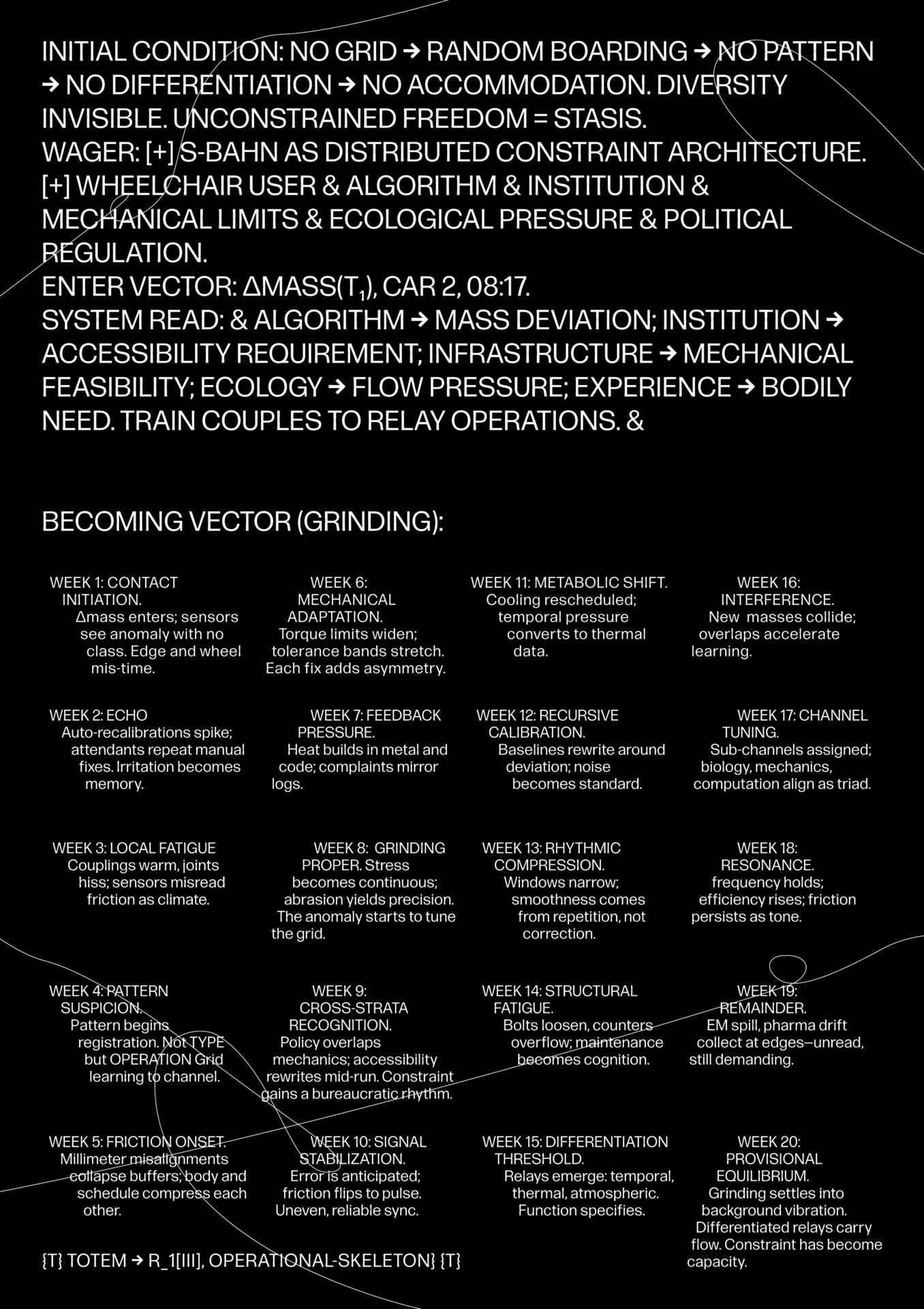
Zone III: Operational Grid (⊞)
Coordinates: 52° 31′ N, 13° 24′ E (Berlin computational matrix)
Terrain Features: Constraint Architectures; Procedural Corridors; Modulation Interfaces
Phenomenon: Becoming Vector
The walker | becomes | an | operational element | within systematic logics | while simultaneously | reconfiguring those systems | through differential movement. Movement | functions as | systemic intervention. Grid | is | rules | in | flux.
Entry Protocol: Bring a pattern from Zone II. Prepare for sustained rhythmic engagement.
Primary Operation: Become a grid editor through small, persistent pressure modulation. Engage constraints with precision to deflect system flow.
Trace Deposit: Reconfigured operational parameters.
Bridge: from ground and grid to the field’s invisible operators: void, mismatch, loop.
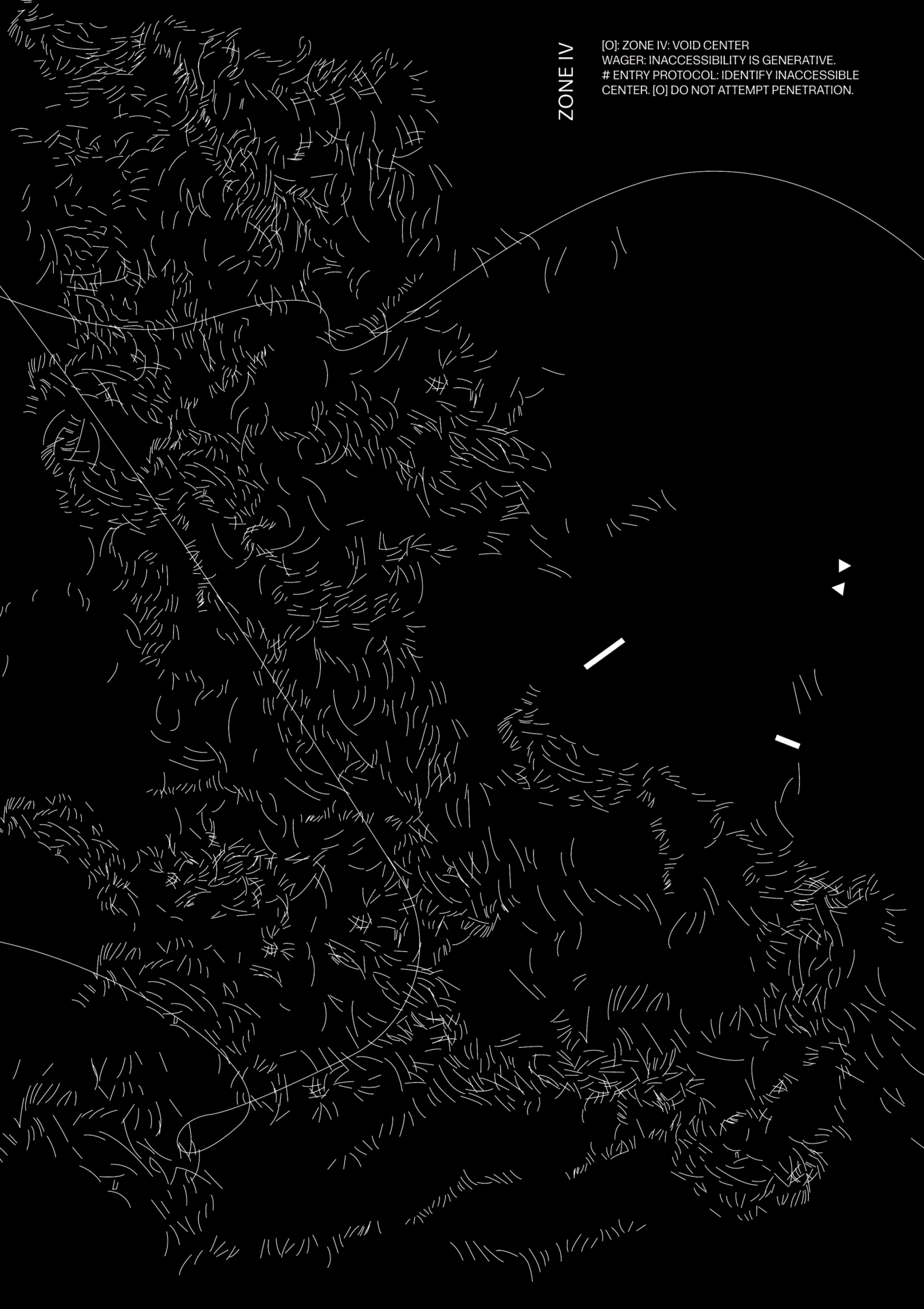
Zone IV: Void Centre ∅
Coordinates: ∅° ∅′ ∅, ∅° ∅′ ∅ (Unlocatable centre, gravitational absence)
Terrain Features: Structural Prohibition; Negative Resonance; Circumferential Intensification
Phenomenon: The Governing Void
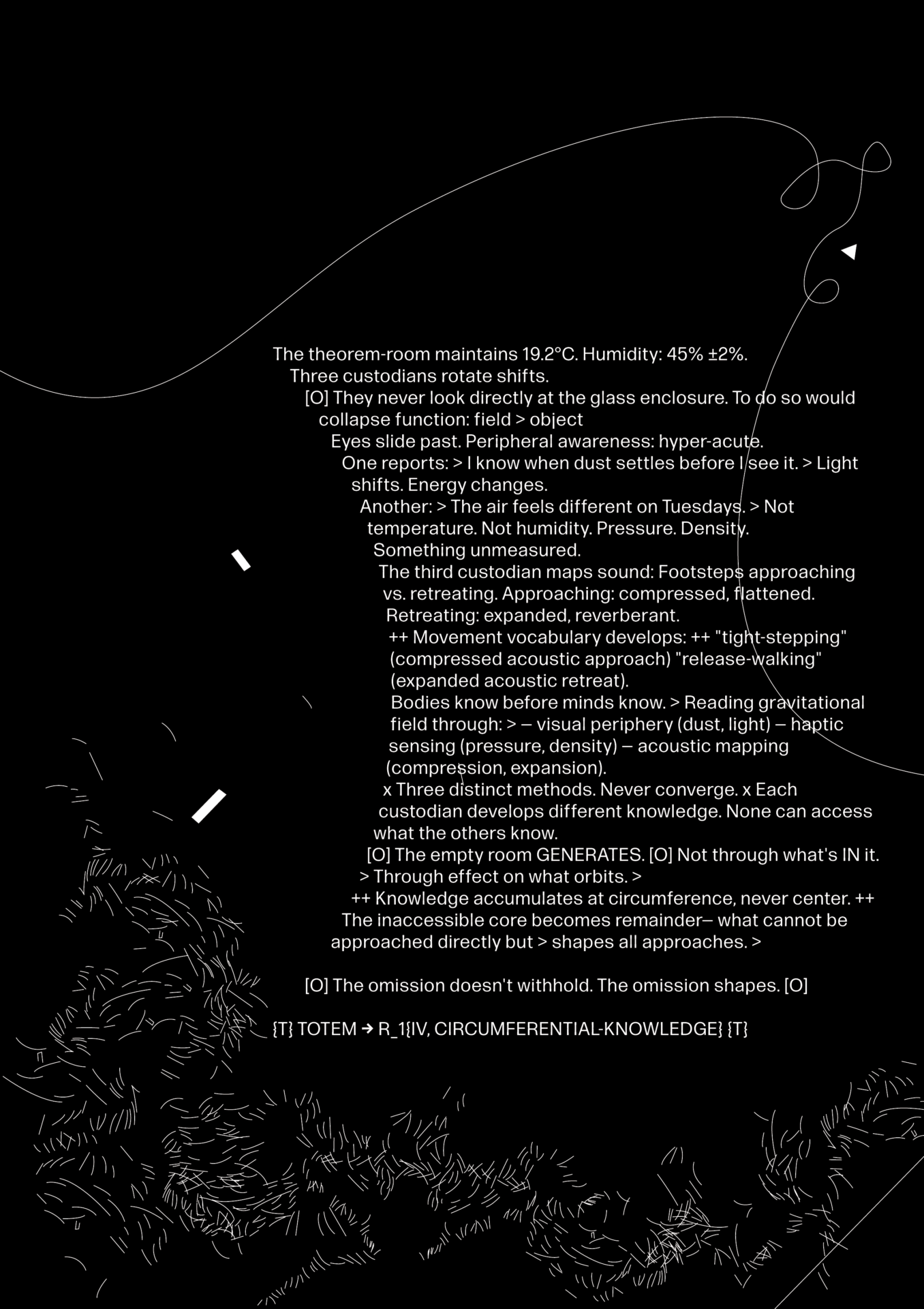
The void materialises as an epistemic centre where structural absence generates cognitive development. Meaning crystallises around what cannot be entered; the void operates as an organisational principle structuring all movements while remaining inaccessible to direct encounter. Form orbits absence, generating knowledge through sustained engagement with systematic prohibition. This is the paradox that demands navigation: how structural absence functions as productive infrastructure rather than negation. Intelligence develops not through penetrating the centre but through learning how prohibition organises the field. The void is not nothingness but a generative principle—absence that governs presence, emptiness that structures fullness.
Each approach to the void yields different knowledge while never converging on the void itself. Optical methods study how the centre distorts perception around it, tracking refraction patterns in how other zones appear when viewed across the void. Topological approaches map the wake structure—how movement near the void curves, how trajectories bend without ever touching the centre. Custodial methods gather peripheral observations, attending to what accumulates at the edges of the inaccessible.
The void functions gravitationally. It does not push or pull directly but organises the entire field through its structural absence. Other zones orient themselves in relation to this centre they cannot occupy. Navigation learns to work with this gravitational force rather than against it—using the void’s organising pressure to enable movements that would be impossible in its absence.
Entry Protocol: Identify the inaccessible centre. Do not attempt penetration. Prepare for sustained circumambulation.
Primary Operation: Orbit the void. Develop three distinct methods that never converge: (1) Optical—study refraction patterns; (2) Topological—map wake structure; (3) Custodial—gather peripheral observations.
Trace Deposit: Gravitational modification of the surrounding epistemic space. Knowledge crystallises circumferentially, never at the centre.
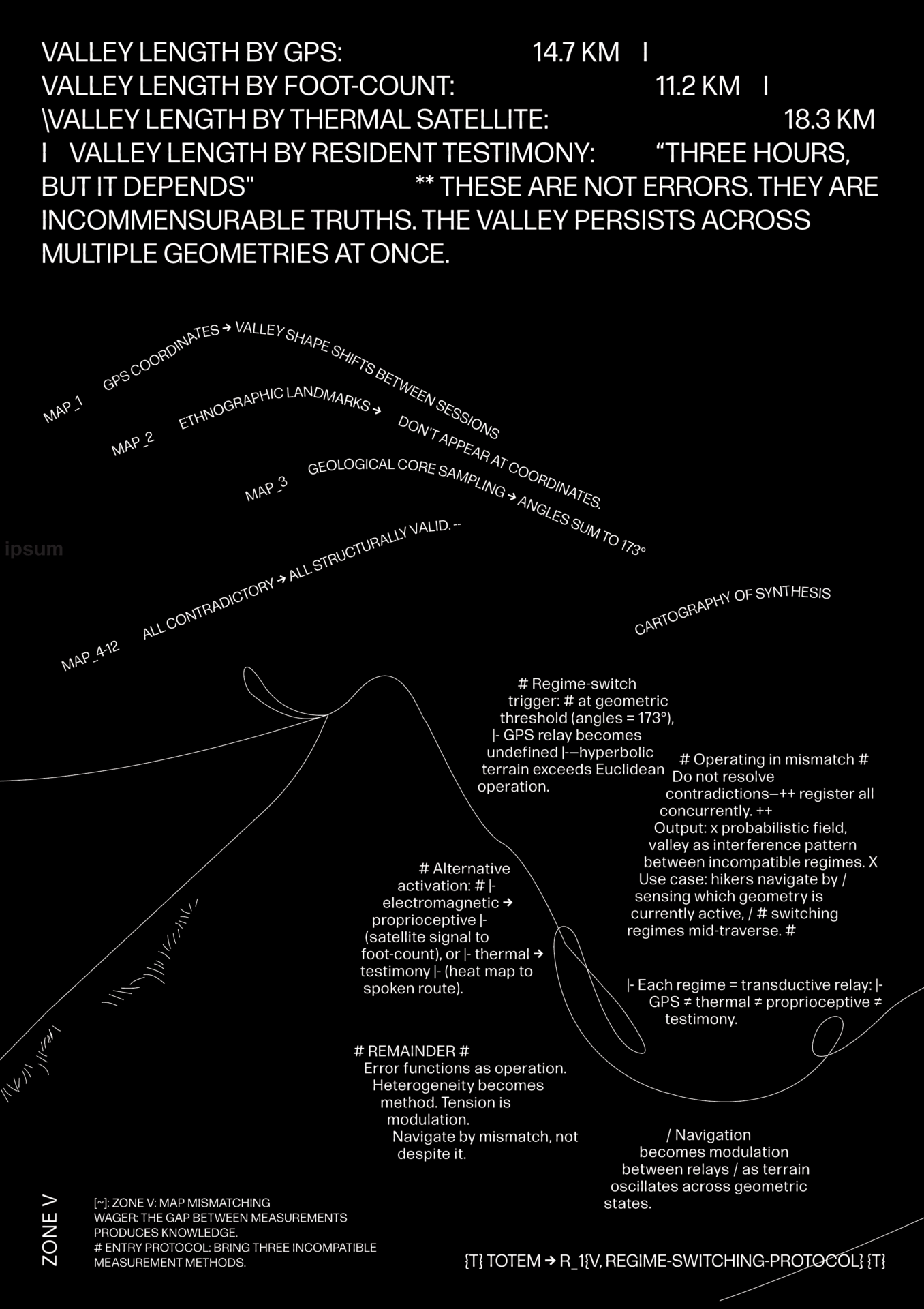
Zone V: Map Mismatching (≈)
Coordinates: Variable (shifting across 47°–49° N, 8°–12° E)
Terrain Features: Modal Incommensurability; Ontological Heterogeneity
Phenomenon: Navigating by Error
The body registers one actuality, measurement captures another, computation processes a third, affective engagement knows a fourth. Each operates in a different mode of being, incommensurable yet simultaneously true. Error names what one ontological register cannot account for in another. Navigation proceeds by composing movement across these heterogeneous fields without resolving them into coherence. Knowledge is not correspondence to a unified reality but agility across incompatible modes of being.
Entry Protocol: Bring three incompatible measurement methods. Navigate by representational failure.
Primary Operation: Measure the same terrain with incommensurable methods: (1) quantitative; (2) qualitative; (3) material. Document contradictions. Navigate using a probabilistic field.
Trace Deposit: Intelligence sedimented in the gap between walkable and speakable.
Bridge: after absence and mismatch, the loop returns pressure to history.
Zone VI: Perpetual Loop (∞)
Coordinates: ∞° ∞′ ∞, ∞° ∞′ ∞ (recursive coordinates; temporal rather than spatial)
Terrain Features: Historical Stratification; Temporal Archaeology; Memory Deposits
Phenomenon: The Differential Loop
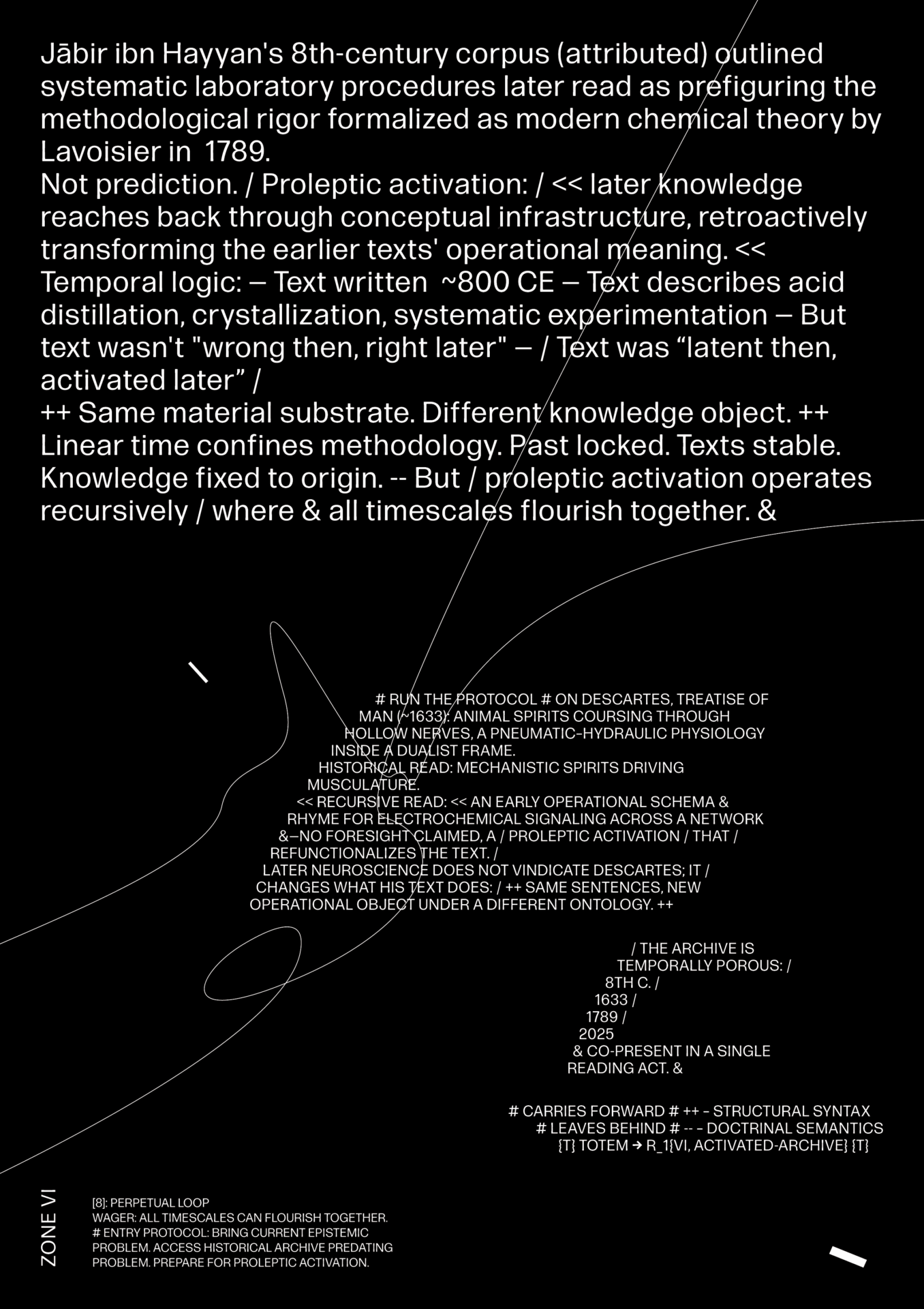
Perpetual Loop activates inherited cognitive infrastructures through differential engagement. Each return reactivates inherited structural patterns under altered conditions; the same structure operates differently when encountered in new contexts. The walker discovers how to enter the same temporal configurations differently, extracting new navigational possibilities from apparently exhausted historical materials.
Time densifies through recursive inhabitation. The apparatus learns to activate history’s persistent operational logics as living cognitive infrastructure. The past becomes a renewable resource; repetition does not repeat but reinventively accumulates difference. Each loop transforms what came before—return alters origin. This is not circular motion but spiral: each rotation occurs at a different altitude, carrying accumulated pressure from prior passes.
The loop operates through proleptic activation: reading old texts through new frameworks, applying contemporary pressure to historical material to see what activates differently. Not content-matching but structural-analogue recognition. A problem today may find its operational logic articulated decades or centuries prior, waiting for new conditions to make it legible. The loop feeds forward: newly activated historical material transforms current approaches, which then transform how other historical texts can be read.
Exit demands return. You cannot leave Zone VI without carrying it back to Zone I, completing the circuit. But the return is never to the same ground—fractured terrain has shifted under the pressure of traversal. The loop ensures that every subsequent entry into the apparatus occurs under altered conditions, preventing the system from calcifying into a fixed method.
Entry Protocol: Bring the current epistemic problem. Access a historical archive predating the problem by decades or centuries. Prepare for proleptic activation.
Primary Operation: Read old texts through new frameworks. Not content-matching but structural-analogue recognition. Activate latent possibilities retroactively.
Recursive Protocol: INPUT: contemporary problem → SEARCH: historical structural analogues → READ: apply new frame to old text → OBSERVE: does the text activate differently? → FEED FORWARD: use activated text for new approaches → LOOP: new work transforms other historical texts.
Trace Deposit: Retroactive transformation of all prior zones. Return alters origin. The walker exits changed, carrying temporal density back to the beginning.
Traversal Protocols
The apparatus becomes operational through traversal choices. Read together, the zones compose an ecology in which local intensities couple into wider pressure-fields. The canonical traversal moves through Fracture, then Ruins, into Grid, passing through Void, arriving at Mismatch, entering Loop, and returning to Fracture. This shows the apparatus as a transductive relay: patterns propagate across unlike domains; excess in one site becomes a parameter in the next.
Theory-fiction here is not pre-written; it is produced by operational choices—each pass lays down conditions the next inherits. The grammar below provides notation for precision and reproducibility.
Wager (Compass). Every run starts with a speculative statement that sets what becomes legible and what counts as trace. The wager aims the traversal; the traversal tests the wager.
Path (Arc). Entry point and route establish narrative shape. A canonical path yields a recognisable arc; a skip or diagonal entry throws the sequence into experiment. The wager often biases path selection.
Coupling (Texture). How zones relate gives the fiction its grain: smooth transitions sustain flow; regime shifts mark discontinuity; relays translate across incompatibles; collisions produce interference; overlap holds partial synthesis. Each coupling decision tunes continuity, rupture, and synthesis.
Temporality (Rhythm). Duration and pacing set tension. Long dwell builds density; rapid crossings spike turbulence. Recursion folds time; repeated loops stratify scenes into a palimpsest. Local modulation refines; steep gradients raise stakes.
Trace (Memory). What you deposit or carry forward becomes motif and constraint. Overlaps among traces generate interference and, at times, flash-organisation.
Speculative Intensity (Emergence). Steeper gradients, tighter couplings, and multiple collisions increase the chance that new patterns condense; shallow gradients and sparse couplings refine what is already there.
This is theory-fiction as method—not layered atop procedure but made by it, in time and space. Each run deposits sediment the next inherits; norms emerge in the wake of operation, not before it.

Epistemic Weather: Toward Poetics-Logic
When procedures that learn by leaking propagate across domains, when liaisons run long enough to generate residues, when constraint-modulation recruits multiple sites, distributed pressure-fields emerge, conditioning entire operational terrains. Epistemic weather names this emergence: the atmospheric medium arising when rules placed in field conditions yield elements beyond themselves. Logic, encountering material friction, temporal drift, and bodily exhaustion, produces latency, hesitation, wear—the unseeable void governing what becomes visible. These yielded remainders are not system failures but productive excess. Poetics-Logic is the intelligence that modulates these remainders, treating what logic cannot account for as a compositional resource.
This is operational poetics: it operates as narrative but not through plot progression; as poetics but not as an expressive supplement; as logic but not as pure formalisation. It is weather that thinks—epistemology conditioned through pressure-field modulation rather than representational grasp.
Distributed pressure-fields condense when fracture, collapse, constraint, opacity, misalignment, and recurrence operate simultaneously across machinic, ecological, and affective systems. These forces function as atmospheric conditions that shape which forms of knowledge become possible. The six zones name characteristic fronts where such pressures intensify; the liaisons compose the winds that carry disturbances across domains. Epistemic weather is the operative medium; thinking happens as weather modulation.
Such conditions necessitate reconceptualising systematic operation beyond cybernetic models that track inputs, outputs, and feedback loops. Where feedback diagrams relations, pressure-field conditioning installs gradients and thresholds that prefigure events. Epistemic weather operates through pressures, densities, and turbulence patterns that exceed mechanistic causation. A rule does not simply regulate behaviour; it creates conditioning effects determining which forms of compliance, deviation, and exhaustion become possible. In Giannotti’s operational scheme, the rule-set functions as a tempo-urbulence dial. It creates zones of differential pressure where rhythms adjust according to field intensities, producing intelligence through ongoing differentials instead of cognitive mastery.
In this sense, Poetics-Logic can equally be read as theory-fiction, forming climates where rules generate conditions rather than narratives. This hyphenated concept sustains productive tension. The procedures remain operative whether engaging machinic systems, institutional arrangements, or aesthetic practices.
Quad demonstrates Poetics-Logic under specific conditions generated by television’s constraints: unforgiving frame, mechanical temporality, broadcast rhythm indifferent to exhaustion. The performers do not interpret rules but navigate the field those rules generate. Their fatigue is not deviation; it is part of the atmospheric dynamic. Exhaustion is not a measurement instrument but how the field registers its own variations. What appears as depletion operates as information about the specific gravity of the rule-field, the systems behind our backs.
This differs systematically from narrative logic, which metabolises anomaly as plot development heading toward determination. In this dynamic terrain, resolution is deferred; density accumulates. Where narrative logic treats anomalies as problems demanding closure, Poetics-Logic maintains leakage as a generative condition; the leak is not solved but stays open as an ongoing source of variants. When performers stumble, when timing drifts, when attention falters, these variables layer atmosphere. They become weather rather than incident, generating speculative density rather than determined narrative meaning.
The field’s accumulation of history operates not only as memory but as atmospheric stratification. Each traversal leaves traces that modify not rules themselves but the pressure-field conditions under which those rules operate. Knowledge here is not about systems but about systemic endurance—the capacity to maintain navigation under pressures exceeding comprehensive understanding. Knowledge exists as specific pressure signatures enabling particular modes of thought rather than propositional content about objects.
This site-specific operation generates irreducible local variation. Each installation of Poetics-Logic mutates through contact with local conditions while maintaining methodological consistency. The method does not replicate across contexts like a stable formula but infects new sites, carrying its operational grammar of constraint-design and remainder-generation into altered terrain. Because the method adapts to local conditions rather than imposing uniform procedures, it demands particular forms of literacy.
Working within epistemic weather requires developing two interconnected competencies. Pressure-field literacy: read differential intensities as compositional material; convert errors in one domain into affordances in another. Remainder sensitivity: treat atmospheric disturbances as structural possibilities rather than problems requiring resolution. What appears as a leak, lag, or mismatch in one register functions as passage into another; ontological incommensurability generates navigational capacity precisely through refusing coherence. The method constructs through error, composes through fragmentation, builds with what will not resolve.
These competencies develop through prolonged exposure rather than theoretical acquisition. To be weathered is to gain pressure-field literacy through staying with live contradiction. Like meteorological sensitivity developed through living in weather systems, they require extended inhabitation of tension, and attention to their variations. They constitute climatic intelligence: the capacity to orient and endure within conditions that exceed cognitive mapping while remaining responsive to navigational possibilities and capable of returning altered.
Recursive Traversal: Holding What Remains Open
After crossing fractured terrains and metabolising collapse, this inquiry has returned to its own threshold. The question that lingers: how can such an apparatus avoid hardening again into a totalising frame? The only durable answer lies in a working habit called holding the remainder open.
This refusal is less ethical stance than operational requirement. Knowledge grows at the gap between action and thought. When the apparatus throws off residues—fatigue spikes, brief hesitations, stray latency—these are not defects but necessary excesses that prevent the mechanism from sealing itself. Error functions as a resource.
Caron’s model insists on maintaining this tension. Real abstraction lives first in material practice before thought names it. Yet becomes thinkable only through mediation within the space of reasons. The gap between enactment and comprehension cannot be erased without losing the very insight that makes it alive. Collapse pattern into pure norm and the Given returns; detach norms from practice and abstraction loses its purchase. Caron’s strength lies in holding both forces without resolution.
Holding the remainder open is a method, not a theme. The six-zone apparatus values its own opacity; silence becomes procedural. A system that accounts for everything calcifies, so the apparatus must preserve what it cannot fully articulate. Opacity is not failure—it shelters still-forming thought.
The work asks for staying-with pressure until fatigue accumulates into matter. At times, the field generates more than can be processed; sites speak through friction instead of compliance.
Remainder collects like dust, eventually dense enough to pull thought back toward its own limits. Yet, this is diagnostic instead of phenomenological. Remainder operates both as a condition and as a material. Exhaustion first marks the constrained field, then becomes the medium of continuation.
Across this project, the notion of remainder shadows every synthesis. Simondon names this in terms of individuation’s “overflow” of preindividual being[5]—a reminder that every formation is shadowed by what it cannot absorb. Yet this is not simply philosophical residue; it is the generative condition through which construction renews itself. Reading with Parisi: treat remainder as the immanent incomputable[6]—random, incompressible data that algorithms prehend and that generate new computational actualities. To keep the remainder open is to refuse any claim to closure, to sustain what Glissant calls the productive opacity of relation, “not enclosure within autarchy but subsistence within an irreducible singularity”,[7] where the Other persists as Other, unassimilated.
This returns to Caron’s displacement of epistemology from the Given to operation. Both empiricism and rationalism collapse before real abstraction’s split nature, at once material and conceptual. Quad demonstrated this: bodies computing through depletion, rules revealing contradiction, an absent centre organising by repulsion. There is no clean method but a field of paradoxes sustaining itself until form condenses from fatigue.
The end, if it exists, is a walk toward futures not yet charted. Mode of Liaisons proposes not a solution but a productive inhabitation of the transmission problem. Instead of finalising knowledge, it works at thresholds where domains leak into each other. Knowledge remains in recursive liaison; Poetics-Logic endures as apparatus in motion, never mastered. Refusing closure ensures thought remains capable of surprise.
Bibliography
Beckett, Samuel. “Quad”. In Collected Shorter Plays. New York: Grove Press, 1984.
Beckett, Samuel, writer. Quadrat I+II. Television play. Aired October 8, 1981, on Süddeutscher Rundfunk (SDR).
Caron, Jean-Pierre. “Real Abstraction and the Given”. In Unpublished Manuscript. N. d. Abridged as section XII in: “Atlas of Experimental Politics”. ŠUM: Journal for Contemporary Art Criticism and Theory, no. 17 (2021).
Giannotti, José Arthur. “Contra Althusser”. Translated by J.–P. Caron. In Exercícios de Filosofia. Petrópolis: CEBRAP, 1980 [1967].
Sohn-Rethel, Alfred. Intellectual and Manual Labour: A Critique of Epistemology. London: Macmillan, 1978.
Bergande, Wolfram. “The Creative Destruction of the Total Work of Art: From Hegel to Wagner and Beyond”. In The Death and Life of the Total Work of Art: Henry van de Velde and the Legacy of a Modern Concept, edited by Carsten Ruhl, Chris Dähne and Rixt Hoekstra. Berlin: JOVIS, 2015.