Šum × Becoming Press × Kult.co × Izhodi: BECOMING LJUBLJANASTROPHE

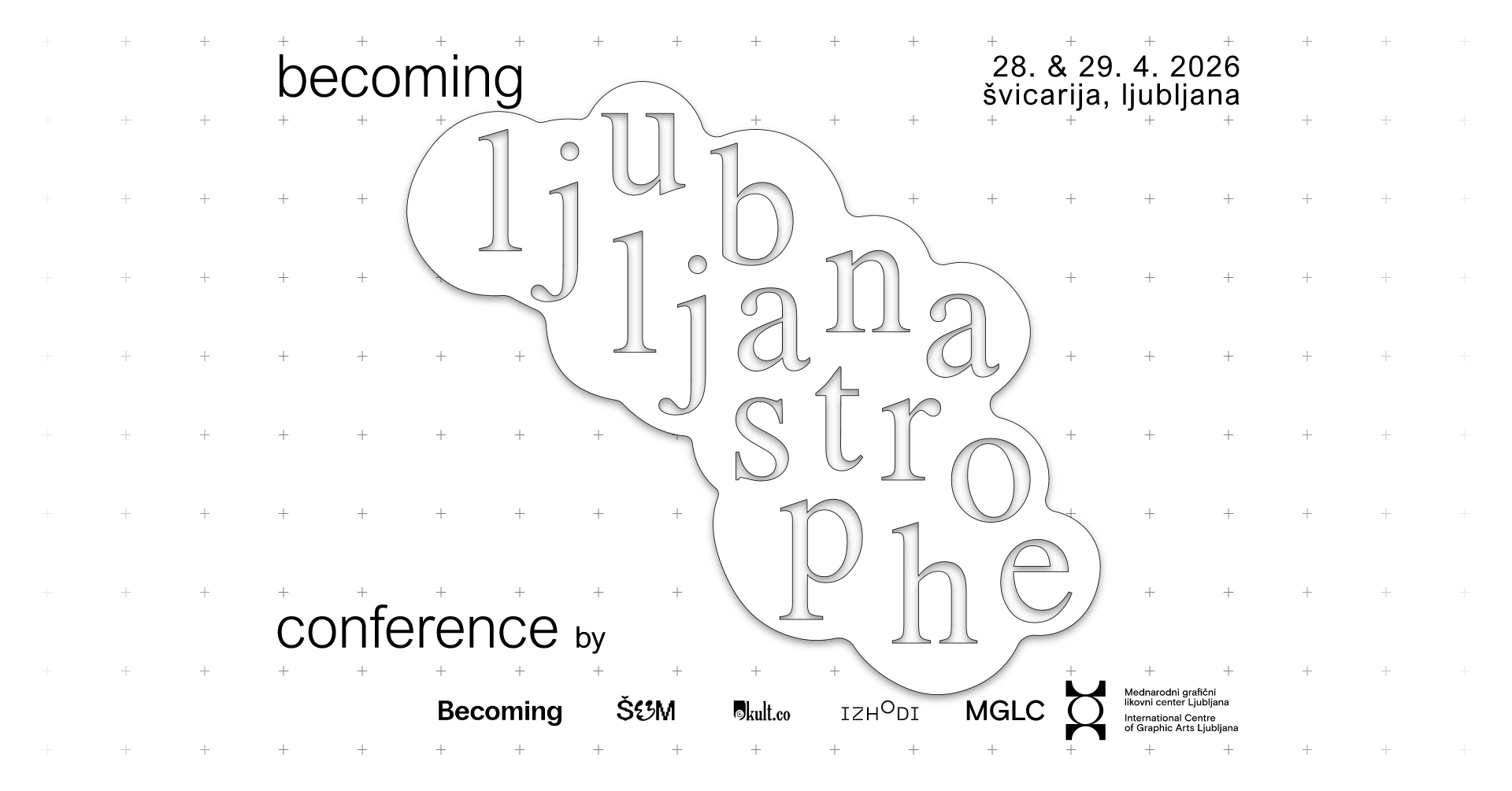
Something has been taking shape in Ljubljana that has not yet received a proper name or institutional canonization. This something has been provisionally named Becoming Ljubljanastrophe.

Šum journal has invited Becoming Press from Berlin and the local Kult.co student collective to jointly organize a two day mini-conference. Special thank you goes to Open Secret collective for making it possible to screen the OS film in Ljubljana for the first time.

The name has a genealogy. Catastrophe is the past coming apart. Anastrophe is the future coming together – Sadie Plant and Nick Land's distinction, sharpened by Amy Ireland into a theory of form as occult technology, then inherited and mutated by Šum #14 under the name Ljubljanastrophe. What the name marks is a shift in cultural production: the future no longer simply arrives – it begins to reorganize the present from within.

Across two days, we will bring together voices engaging with philosophy, theory-fiction, psychoanalysis, internet culture, digital metaphysics, and media theory in order to ask what kinds of conceptual and aesthetic forms become possible once the internet is no longer treated as a novelty, but as ontology; when “cyberspace” is no longer a metaphor, but an infrastructural unconscious; and when the virtual is no longer elsewhere, but the very texture through which contemporary reality is composed.

Šum × Becoming Press × Kult.co × Izhodi:
Becoming Ljubljanastrophe
28 & 29 April 2026 / 17:00 – 21:00
@ MGLC Švicarija, Ljubljana

Christian Nirvana Damato / Maks Valenčič / Ivan Slijepčević / Claire Elise / Alessandro Sbordoni / Lea Sande & Tisa Troha / Stefan Kafidov / Enea Kavčič / Open Secret

Day 1

Christian Nirvana Damato: “Retrograde Prometheus”

Christian Nirvana Damato is a philosopher, writer, and curator, who authored the books Multiplication of Organs Manifesto (2025) and Digisexuality (2025), Christian Nirvana Damato, presents a lecture stemming from a research project on computation and subjectivity which culminated in his latest book, Retrograde Prometheus (2026).

Maks Valenčič: “Psychotic Accelerationism”

It is striking how much theory is not only neurotically coded, but also neurotically naturalized. To break with that naturalization, psychosis must be introduced in the structural Lacanian sense as an alternative starting point. From there, a different subjective terrain comes into view, one that allows us to map the present more precisely.

Ivan Slijepčević: Cyberspace in vogue

A “spectre of the virtual” haunts the modern world as online spaces increasingly shape real-world politics, culture, and organic perception, thus increasingly blurring the line between cyberspace and the physical in an uneven relationship. This talk examines those dynamics, their risks, and emerging efforts to grant the virtual world autonomy by potentially severing it from the physical.

Claire Elise (Becoming Press): “Guided Q&A”

The first day concludes with a Q&A session, mediated by Claire Elise, which will attempt to open up a dialogue between the presenters and audience, as well as create time and space where the audience can raise any questions that have been percolating throughout the day.

Day 2

Alessandro Sbordoni: "Digital Death Drive"

Author of Semiotics of the End (2023) and Beyond the Image (2025), Alessandro Sbordoni is a writer, editor and researcher based a stone’s throw away, in Trieste. Alessandro’s work orients around media, language and the metaphysics thereof, and will be presenting some new research into what he is calling the digital death drive.

Lea Sande & Tisa Troha: “Epistemological Machines”

Lea Sande and Tisa Troha are researchers, writers and editors. Their collaborative work examines how structures of knowledge and representation embed themselves in emerging technologies. In this talk, they approach black holes as epistemological machines, appropriating the concept of faciality to analyze how knowledge is structured through the relation between a visible surface (event horizon) and an inferred, unobservable center (singularity).

Enea Kavčič: "Resident Evil. Internet"

Devil appears precisely when he can be shown without punishment. Instead of tempting or frightening us, he now appears as the absence of consequence itself, reflecting our infinite loop of justification where users on the internet betray their own freedom in exchange for something - what? Judgment day is here but it's no longer intelligible. Meme or die.

Stefan Kafidov: "Wired Subjects"

Talking about the emancipatory potential of the internet like it’s still the 90’s – new emerging kinds of identities, shifts in the mechanics that lie at the base of discourses and cognitive territories, applying the psychology behind memes onto everything ever. Trying to decipher Simulacra and Simulation in a less moral panicky way, embracing the hyperreal without shame as a space where we truly belong.

Maks Valenčič (Šum): “Guided Q&A”

The second day also features a Q&A session, moderated by Maks Valenčič, which will open up a dialogue between the presenters and the audience, while creating space for questions that have been percolating throughout the day.

Open Secret Screening

Open Secret is a cinema-oriented gathering which exhibits both an emergent approach to the production of meaning using moving-images which assigns a primacy to the editor, and an emergent approach to the circulation of these moving-images. Until now, there have been free-to-attend Open Secret events in over 60 countries worldwide, as people are able to organize screenings in their home cities; you choose the venue, and they curate the line ups from an ever-expanding repertoire of films from a wide range of film-makers and artists.

Publications by Becoming Press and Izhodi, as well as copies of the Šum Journal, will be on display.

Production: Šum Journal in collaboration with Becoming Press and the Kult.co collective

Special thanks to MGLC and Dušan Dovč (MGLC Švicarija) for providing the space and assistance with the arrangements.

(SI)

V mestu se formira nekaj, kar še ni dobilo pravega imena ali institucionalne kanonizacije, nekaj, kar smo začasno poimenovali Becoming Ljubljanastrophe.

Šum je k srečanju povabil berlinsko založbo Becoming Press in lokalni študentski kolektiv Kult.co. Posebna zahvala gre kolektivu Open Secret, ki je omogočil prvo projekcijo svojega filmskega programa OS v Ljubljani.

Imenovanje ima svojo genealogijo. Katastrofa je razpadanje preteklosti. Anastrofa je sestavljanje prihodnosti – distinkcija Sadie Plant in Nicka Landa, ki jo je Amy Ireland izostrila v teorijo forme kot okultne tehnologije. Šum je že v svoji štirinajsti ediciji (#14) ta pojem podedoval, ga mutiral in mu nadel ime Ljubljanastrophe. Imenovanje označuje premik v kulturni produkciji: prihodnost ne prihaja več od zunaj kot nekaj, kar se zgodi pozneje, temveč začne iz notranjosti preoblikovati sedanjost.

V dveh dneh mini-konference bomo prisluhnili naboru glasov, ki skozi filozofijo, teorijo-fikcijo, psihoanalizo, internetno kulturo, digitalno metafiziko in medijsko teorijo premlevajo, katere konceptualne in estetske forme postanejo mogoče, ko internet ni več mišljen kot novost, temveč kot ontologija; ko »kibernetski prostor« ni več metafora, temveč infrastrukturno nezavedno; in ko virtualno ni več nekje drugje, temveč vseprisotna tekstura, iz katere je stkana sodobna realnost.

Šum × Becoming Press × Kult.co × Izhodi:
Becoming Ljubljanastrophe
28. & 29. april 2026 / 17:00 – 21:00
@ MGLC Švicarija

Christian Nirvana Damato / Maks Valenčič / Ivan Slijepčević / Claire Elise / Alessandro Sbordoni / Lea Sande & Tisa Troha / Stefan Kafidov / Enea Kavčič / Open Secret

Dan 1

Christian Nirvana Damato: »Retrogradni Prometej«

Christian Nirvana Damato je filozof, pisec in kurator, avtor knjig Multiplication of Organs Manifesto (2025) in Digisexuality (2025). V prispevku bo izhajal iz raziskovalnega projekta o komputacijiin subjektivnosti, ki je kulminiral v njegovi najnovejši knjigi Retrograde Prometheus (2026).

Maks Valenčič: »Psihotični akceleracionizem«

Presenetljivo je, kako močno je teorija ne le nevrotično kodirana, temveč tudi nevrotično naturalizirana. Da bi prelomili s to naturalizacijo, je potrebno vpeljati psihozo v strukturnem, lacanovskem smislu kot alternativno izhodišče. S tem Maks Valenčič razpre drugačno subjektivno krajino, ki nam omogoči natančnejšo kartografijo sedanjosti.

Ivan Slijepčević: »Kibernetski prostor kot norma«

‘Spekter virtualnega’ preganja sodobni svet, saj spletni prostori vse bolj oblikujejo politiko, kulturo in organsko percepcijo, s tem pa v neenakomernem razmerju vse bolj zabrisujejo mejo med kibernetskim prostorom in fizičnim svetom. Predavanje bo obravnavalo te dinamike, njihova tveganja ter nastajajoče poskuse, da bi virtualnemu svetu podelili avtonomijo, potencialno z njegovo ločitvijo od fizičnega.

Claire Elise (Becoming Press): Moderirana diskusija

Ob zaključku dneva bomo skozi format odprtega pogovora vzpostavili prostor za razpravo o vprašanjih in tematikah, ki bodo med programom vzniknile med prisotnimi. Pogovor bo moderirala Claire Elise.

Dan 2

Alessandro Sbordoni: »Digitalni gon smrti«

Pisec, urednik in raziskovalec, avtor knjig Semiotics of the End (2023) in Beyond the Image (2025) prihaja iz bližnjega Trsta. Njegovo delo se osredotoča na medije, jezik in njuno vzajemno metafiziko. Predstavil bo najnovejšo raziskavo o tem, kar sam imenuje digitalni gon smrti.

Lea Sande & Tisa Troha: »Epistemološki stroji«

Lea Sande in Tisa Troha sta raziskovalki, piski in urednici. Njuno skupno delo raziskuje, kako se strukture vednosti in reprezentacije vpisujejo v nastajajoče tehnologije. V predavanju bosta obravnavali črne luknje kot epistemološke stroje, pri čemer uporabljata pojem »facialnosti«, da bi analizirali, kako se znanje strukturira skozi odnos med vidno površino (horizontom dogodkov) in domnevnim, neopaznim središčem (singularnostjo).

Enea Kavčič: »Resident Evil. Internet«

Hudič se pojavi natanko tedaj, ko ga je mogoče pokazati brez kazni. Namesto da bi nas zapeljeval ali strašil, se danes pojavlja kot sama odsotnost posledice, kot odsev naše neskončne zanke upravičevanja, v kateri uporabniki interneta izdajajo lastno svobodo v zameno za nekaj – za kaj? Sodni dan je tukaj, vendar ni več razumljiv. Memaj ali umri.

Stefan Kafidov: »Omrež(e)ni subjekti«

Govor o emancipatornem potencialu interneta, kot da bi bili še vedno v devetdesetih – o novih oblikah identitete, premikih v mehanikah, ki tvorijo osnovo diskurzov in kognitivnih teritorijev, o apliciranju psihologije memov na prav vse. Poskus dešifriranja ‘simulakra’ in ‘simulacije’ onkraj moralne panike, ter sprejetje hiperrealnega brez sramu kot prostora, ki mu zares pripadamo.

Maks Valenčič (Šum): Moderirana diskusija

Tudi ob zaključku drugega dneva bomo skozi format odprtega pogovora odprli prostor za razpravo o vprašanjih in tematikah, ki bodo med programom vzniknile med prisotnimi. Pogovor bo moderiral Maks Valenčič.

Projekcija »Open Secret«

Open Secret je srečanje, posvečeno filmski podobi, ki temelji na svežem pristopu k produkciji pomena skozi gibljive podobe – pri katerem osrednjo vlogo prevzame urednik– kot tudi novem načinu njegove distribucije. Do danes so se Open Secret srečanja odvila v več kot 60 državah po svetu, saj angažma prevzamejo posamezniki v različnih mestih: sami izberejo prizorišče, kolektiv pa kurira program iz vedno večjega nabora filmov različnih filmskih ustvarjalcev in umetnikov.
Na ogled bodo fizični izvodi založb Becoming Press in Izhodi ter izvodi revije Šum.

Produkcija dogodka: Šum v sodelovanju s Becoming Press in kolektivom Kult.co.

Posebna zahvala: MGLC in Dušanu Dovču (MGLC Švicarija) za prostor in pomoč pri organizaciji.